
Review velocity is how often new reviews arrive, and a steady trickle is worth more than an occasional burst. Steady looks like a business that is trading and asking; a spike followed by silence looks like a campaign, reads as arranged to customers, and leaves the profile stale again within months. Aim for a rate you can sustain from your actual job volume, and measure the gap since the last review rather than the total.
Plot any business’s reviews by month and the chart tells you more than the star rating does. Most look like a heartbeat that stopped.
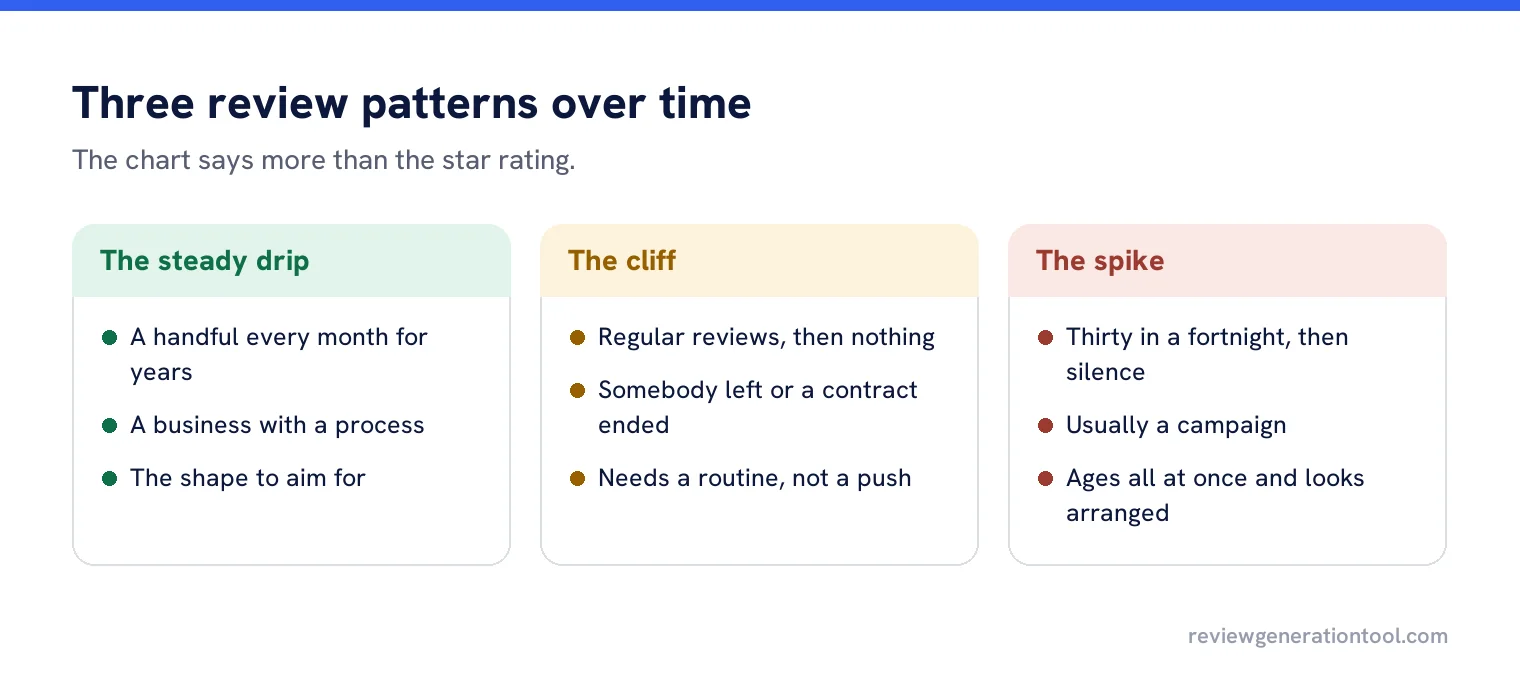
The three shapes
The steady drip
A handful every month for years. A business with a process, and the shape to aim for.
The cliff
Regular reviews up to a date, then nothing. Somebody left, or an agency contract ended.
The spike
Thirty in a fortnight, then silence. Usually a campaign, occasionally something worse.
Why steady beats bursts
Customers read the newest reviews first, so a steady flow means the top of your profile is always current. A spike only looks good for a few weeks and then ages all at once, leaving a profile where every review is from the same fortnight two years ago.
There is also the appearance of it. A sudden run of five star reviews with little text, all within days, is the pattern that makes a careful customer suspicious, and the same pattern is visible to anyone reviewing the profile for policy reasons.
Working out a sustainable rate
| Jobs or customers per month | A realistic review rate |
|---|---|
| 20 | 2 to 4, with consistent asking |
| 60 | 6 to 12 |
| 200 | 15 to 40 |
| 1,000 (high footfall) | Highly variable, often a much lower percentage |
The conversion rate from ask to review varies enormously by trade, by how the ask is made and by whether customers are signed into a Google account. The number to care about is your own, measured over a quarter, not an industry average.
Weekly rather than monthly
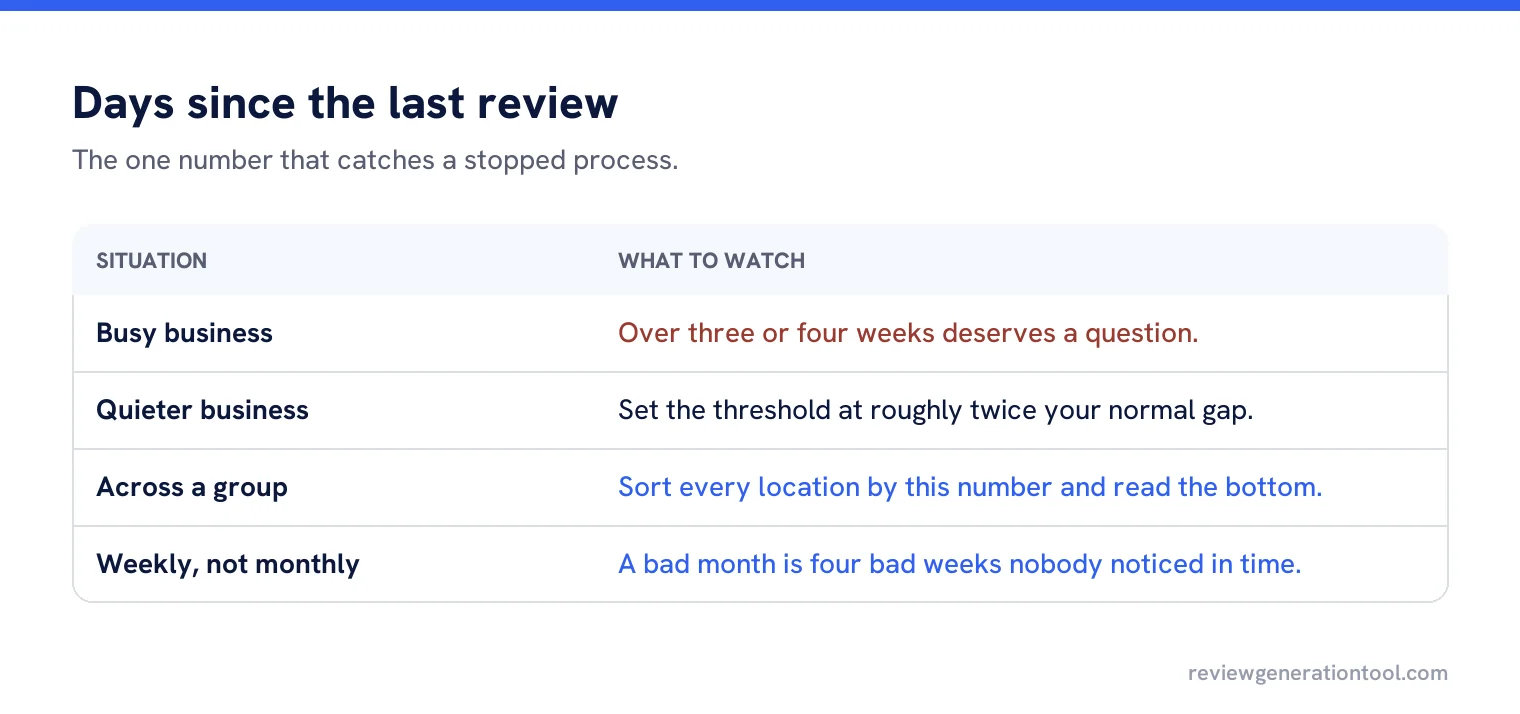
Monthly charts are for reporting. For running the process, a weekly count is more useful, because a bad month is four bad weeks nobody noticed in time. One line in a Monday message is enough: reviews last week, and days since the last one.
The metric to actually watch
Days since the last review. It is simple, it is visible from the public profile, and it captures the thing that goes wrong: the asking stopped and nobody noticed. For a busy business, anything over three or four weeks deserves a question. For a quieter one, set the threshold to roughly twice your normal gap.
Across a group, sort the locations by that number and look at the bottom of the list. Those branches have a process problem, and it will usually be the same cause at all of them.
Recovering from a cliff
Do not run a campaign. Resume asking every customer, from today, and accept that it will take a few months to look normal again. A catch-up push produces exactly the spike shape you were trying to avoid and teaches the team that review generation is an occasional project rather than part of the job.
The one legitimate exception is a business that has genuinely never asked. Starting from zero produces an unavoidable rise, and that is fine, because it is accompanied by a permanent change in process rather than being a one-off.
Reviews that never appear
Some requests convert into a review that nobody can find. Reviews can be delayed or filtered for reasons outside your control, and a customer who insists they left one is usually telling the truth. The two most common explanations are a review posted from an account with no history, and a review written in a way that tripped an automated check.
There is nothing useful to do about an individual case beyond asking the customer to check it is still showing on their own account. What matters for velocity is not treating these as failures of the process: if ten people are asked and eight say they left a review while six appear, the asking is working and the gap is the platform’s.
Seasonal businesses
A seaside hotel or a garden centre has months with no customers, so velocity will be seasonal and that is expected. What matters is that reviews track trading: busy months produce reviews, quiet ones do not, and the pattern repeats each year. A profile whose reviews stop in June while the business is at its busiest is telling you something about the process rather than about demand.
A worked example
A tyre and exhaust centre with 210 reviews, averaging 4.6. The monthly chart showed roughly eight a month for two years, then four months with none, then a burst of fourteen in one week, then nothing for five weeks.
The explanation was ordinary: the manager who asked every customer left, nobody took it on, then head office noticed the gap and ran a week of chasing old customers. The burst was followed by silence because it was a push, not a process.
The fix was one sentence added back into the handover routine at the counter, and a weekly glance at days since the last review. Within two months the chart looked like the first two years again.
Velocity after a bad review
The instinct after a one star review is to ask several happy customers quickly to bury it. The result is a visible burst immediately after a complaint, which is a pattern anyone reading the profile can see, and the bad review stays near the top of the list anyway because recent reviews are shown first.
The better response is the dull one: reply to it properly, and keep the normal asking rate going so the profile continues to look like a business rather than a reaction.
What to tell an owner
Show the monthly chart rather than the total. It is the only review metric most owners immediately understand, and it makes the argument for a routine better than any explanation of ranking factors. The sentence that lands is usually: your reviews stopped in March, and so did the enquiries from people who read them.
Watch the gap, not just the total
See days since the last review for every location, and get told when a profile goes quiet.
Frequently asked questions
What is review velocity?
How often new reviews arrive. A steady monthly trickle is worth more than an occasional burst, because customers read the newest reviews first.
Is a sudden burst of reviews a problem?
It ages all at once and leaves the profile stale within months, and a run of short five star reviews within days is the pattern that looks arranged.
What rate should I expect?
It depends on your job volume and how the ask is made. Measure your own conversion from ask to review over a quarter rather than using an industry average.
What single number should I watch?
Days since the last review. It is visible from the public profile and it catches the thing that actually goes wrong: the asking stopped.
How do I recover after reviews stopped?
Resume asking every customer from today and accept a few months to look normal. A catch-up campaign recreates the spike you were trying to avoid.
Sources
The Google documentation behind the guidance on this page. Google changes these pages without notice, so check the date on any figure before you rely on it.