
Review gating is asking customers how they feel first, then sending only the happy ones to Google and diverting the unhappy ones to a private form. It produces a profile that misrepresents the business, and it conflicts with the requirement that reviews reflect genuine experience. In the United States the FTC rule on consumer reviews and testimonials, which came into force on 21 October 2024, also bars practices that suppress or misrepresent reviews. Ask everyone, the same way, with the same link.
Gating is popular because it works, briefly, in the sense that a rigged sample produces a better average. It is also the clearest line in review generation, and plenty of software still sells it as a feature.
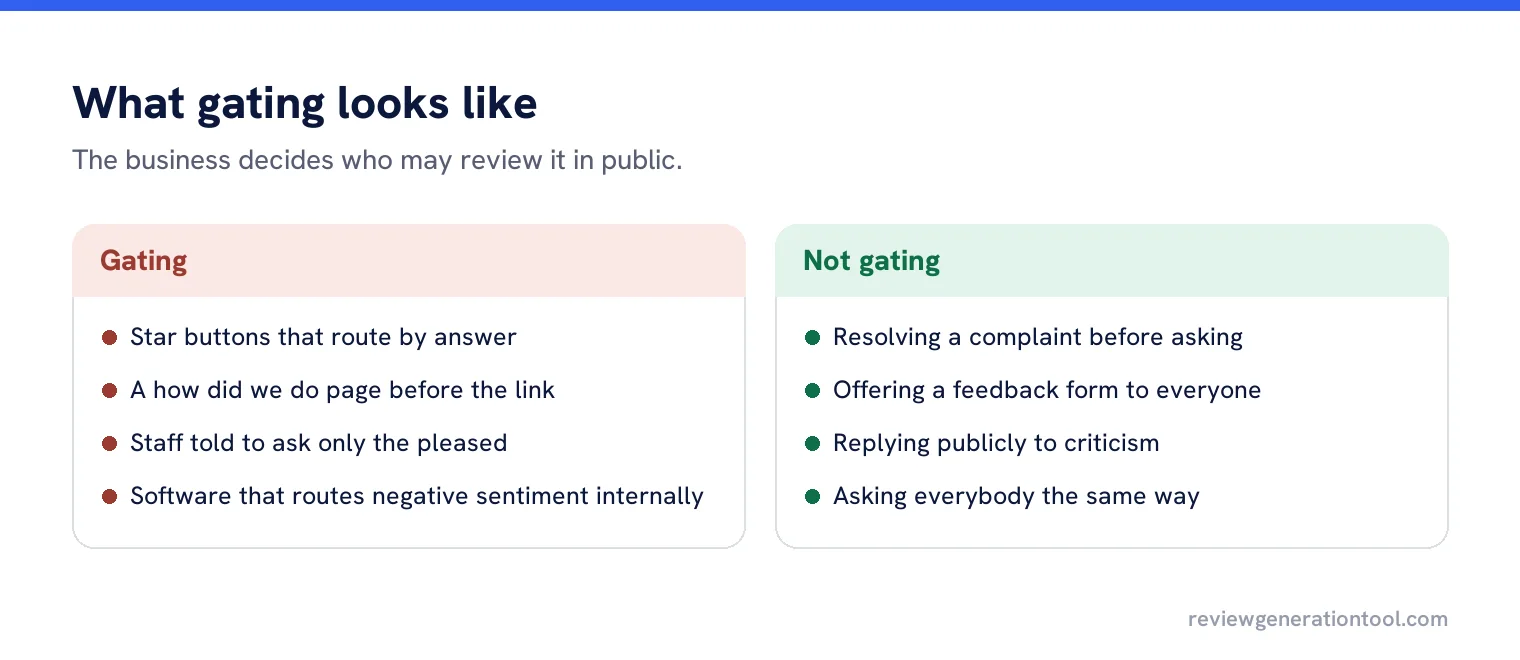
What gating looks like
- An email asking for a star rating, where four and five stars lead to Google and one to three lead to a feedback form.
- A QR code landing on a “how did we do?” page before the review link.
- Staff told to ask only customers who seemed pleased.
- A kiosk that offers the Google link only after a positive answer.
- Software that “routes negative sentiment internally”.
All five share the same structure: the business decides who is allowed to review it in public.
Why it is a problem
It misrepresents the business
The average is built from a filtered sample, which is the definition of a misleading rating.
It conflicts with the platform rules
Google requires reviews to reflect genuine experience and treats practices that manipulate review content as prohibited.
It may breach consumer protection law
The FTC rule in force since 21 October 2024 addresses fake and suppressed reviews directly.
It is visible
A profile with 300 reviews and no criticism at all reads as arranged to anyone paying attention.
The FTC rule, briefly
The United States rule on consumer reviews and testimonials covers fake and AI-generated reviews, reviews by insiders, buying positive or negative reviews, and the suppression of negative reviews, among other practices. It came into force on 21 October 2024. The detail matters most to businesses trading in the US, and the principle travels: a rating built by filtering is a misleading rating.
Note one difference worth knowing. The FTC rule focuses on incentives conditioned on the sentiment of the review. Google goes further and prohibits incentives for reviews at all. Follow the stricter rule, which is Google’s, for anything that ends up on a Business Profile.
What to do instead
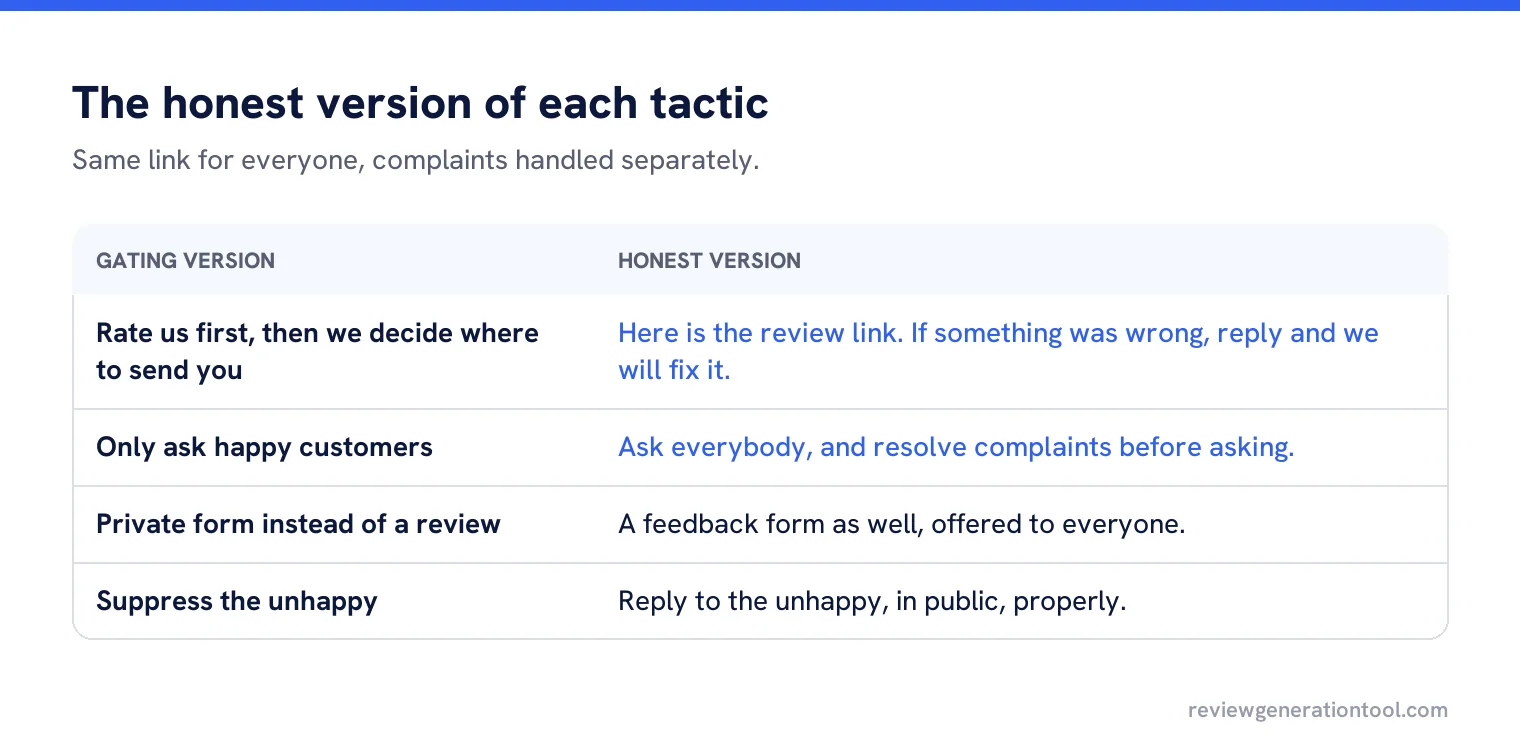
Ask everybody the same way, with the same link, at the same point in the job. Then add the one thing gating was really trying to achieve: a genuine route for complaints that exists before and independently of the review request.
| Gating version | Honest version |
|---|---|
| Rate us first, then we decide where to send you | Here is the review link. If something was wrong, reply and we will fix it. |
| Only ask happy customers | Ask everybody, and resolve complaints before asking. |
| Private feedback form instead of a review | A feedback form as well, offered to everyone. |
| Suppress the unhappy | Reply to the unhappy, in public, properly. |
Surveys are not the same thing
A customer satisfaction survey is a perfectly good tool and it is not a review funnel. Run it if it helps you improve the service, read the results, and keep it separate from the review request. The moment the survey result decides who sees a review link, it has stopped being a survey.
The sequencing point, which is not gating
Fixing a problem before asking for a review is legitimate, and it is not the same as filtering. The difference is whether the customer eventually gets the same opportunity as everybody else. Resolving a complaint and then asking is fine. Resolving a complaint and quietly removing that person from the request list is not.
Why gating stops working anyway
Even on its own terms it decays. The filtered customers are still customers, and some of them write the review regardless, usually more pointedly because they were given a form instead of a voice. Meanwhile the profile fills with uniformly positive reviews that look alike, and conversion from a suspiciously perfect profile is worse than from a believable one.
Spotting it in software
When buying review software, ask one question: does every customer receive the same link regardless of how they answer anything? If the answer involves routing, sentiment, or protecting your rating, the product is selling gating, whatever it is called in the marketing.
The honest feedback form
Businesses adopt gating because they want a private channel for complaints, and that is a reasonable thing to want. Build it properly and it costs you nothing: a short feedback form linked from the same message as the review link, offered to everyone, with a named person reading it.
The difference from gating is the order and the audience. Everybody gets both options at the same time, nobody is sorted by sentiment, and choosing to tell you privately is the customer’s decision rather than yours. Some will do both, which is a good sign rather than a problem.
What a healthy profile looks like
Mostly positive, with a few middling reviews, some criticism, and owner replies to the difficult ones. Google itself says a mix of positive and negative feedback often feels more trustworthy. Customers read the negative reviews first and judge the business on the reply, which is a far better use of effort than preventing the review from existing.
Staff incentives, which are the same problem
Paying staff a bonus per five star review is gating with extra steps. It makes the rating the goal rather than the service, and it pushes people to ask selectively, coach customers, or in the worst cases write reviews themselves. If you want to recognise the team, recognise the reviews that name somebody, and keep money out of it.
If you have been gating
Stop, and expect the average to fall slightly. That is the rating the business actually has, and it is defensible. Then do the two things that matter more than the number: reply to every critical review, and fix whatever two or three complaints keep repeating. Within a few months most businesses find the honest profile converts better than the curated one did.
Ask everyone, properly
Send the same request to every customer, handle complaints in one place, and keep the profile honest.
Frequently asked questions
What is review gating?
Asking customers how they feel first, then sending only the positive ones to the review link while diverting the rest to a private form.
Is review gating against the rules?
It conflicts with the requirement that reviews reflect genuine experience, and in the US the FTC rule on consumer reviews, in force since 21 October 2024, addresses suppressed reviews.
Is it gating to fix a complaint before asking?
No, provided the customer still gets the same opportunity as everybody else afterwards. Quietly removing them from the list is where it becomes filtering.
How do I tell if software is gating?
Ask whether every customer receives the same link regardless of how they answer anything. Routing by sentiment is gating whatever it is called.
What happens if I stop gating?
The average usually falls slightly to the rating the business actually has. Reply to criticism and fix the repeated complaints, and the honest profile tends to convert better.
Sources
The Google documentation behind the guidance on this page. Google changes these pages without notice, so check the date on any figure before you rely on it.