
The in-person ask is the one that works, and it fails for one reason: staff find it awkward. Fix that with a script of about fifteen words, a clear moment in the routine to say it, and a rule that nobody has to chase anybody. Ask everyone the same way, offer nothing in return, and hand over a link or a card rather than asking them to search for you.
Asking for reviews in person costs nothing, and businesses spend money on review software and skip the step that costs nothing: somebody saying a sentence at the end of the job.
Why asking out loud works
Three reasons. The customer is in front of you and already pleased. They are being asked by a person rather than a system. And a text or email that follows an in-person ask is expected rather than unsolicited, which changes how it is read.
The conversion difference is large enough that a business with a weak in-person habit and good software usually gets fewer reviews than a business with a good habit and no software at all.
The fifteen word script
“If you have a minute, a Google review would really help us. I’ll send the link.”
That is it. It is short enough to say while packing a toolbox, it contains no pressure, no star guidance and no incentive, and it ends with an action that puts the link in their hand.
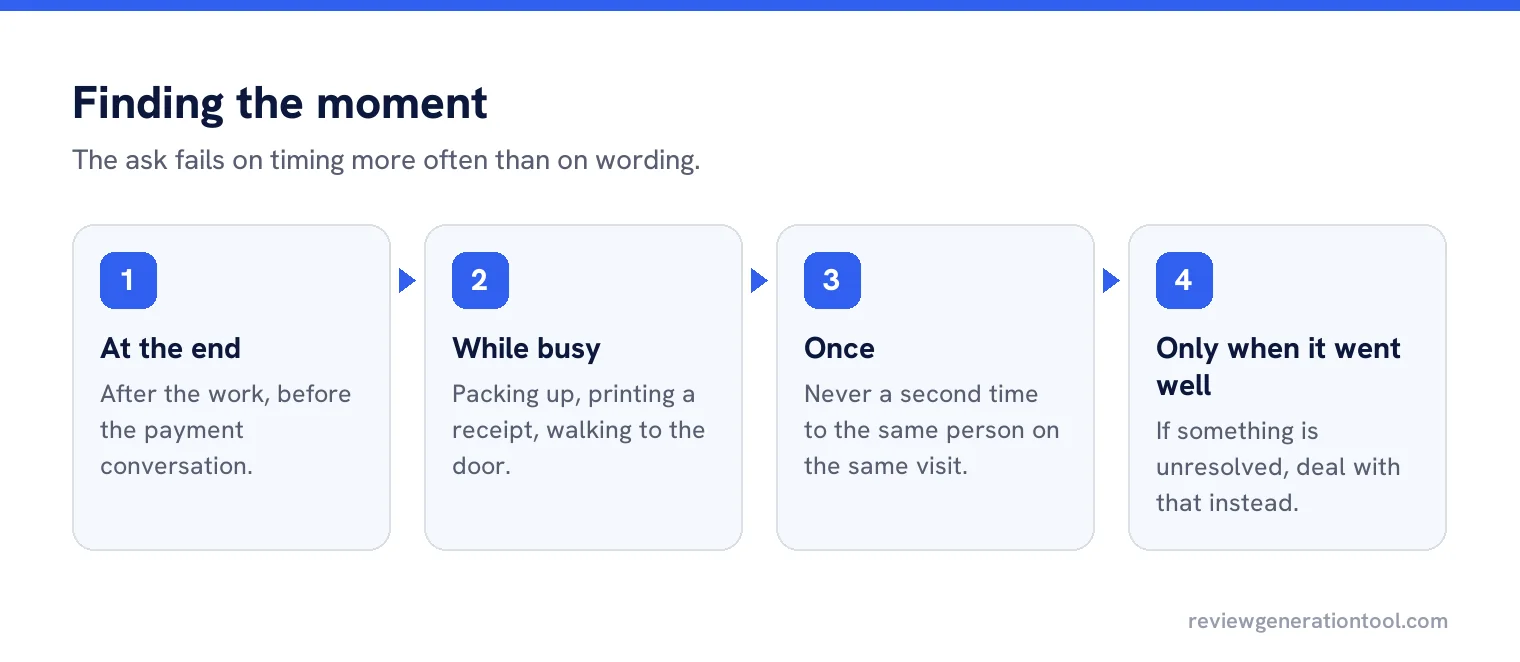
Finding the moment
At the end, not the start
After the work, before the payment conversation.
While something is already happening
Packing up, printing a receipt, walking to the door. Standing still to ask makes it feel formal.
Once
Never a second time to the same person on the same visit.
Only when it went well
Not filtering, judgement: if there is an unresolved problem, deal with that instead.
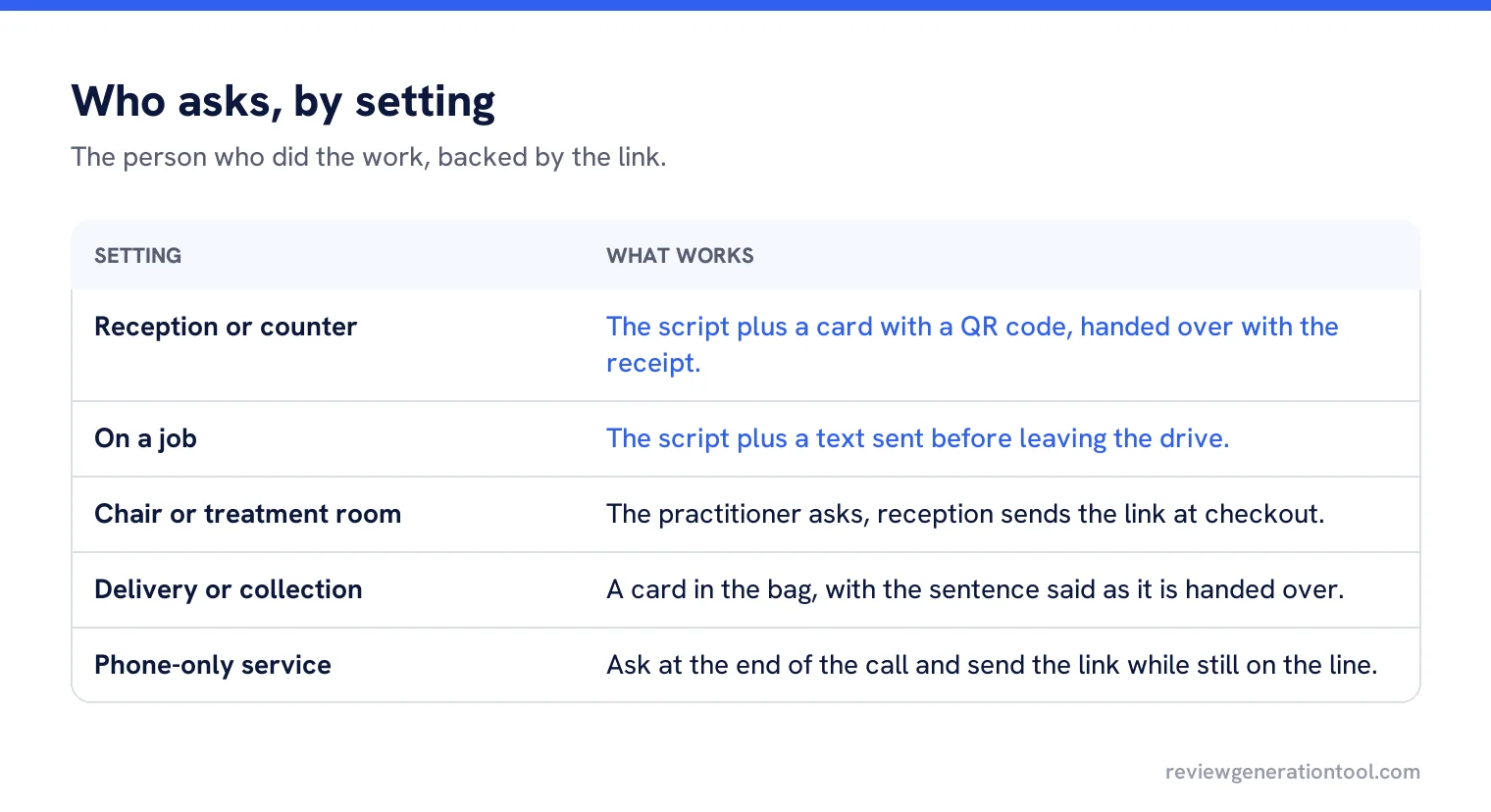
Front desk versus field
| Setting | What works |
|---|---|
| Reception or counter | The script plus a card with a QR code handed over with the receipt. |
| On a job | The script plus a text sent before leaving the drive. |
| Chair or treatment room | The practitioner asks, reception sends the link at checkout. |
| Delivery or collection | A card in the bag, with the script said as it is handed over. |
| Phone-only service | Ask at the end of the call and send the link while still on the line. |
Training it in twenty minutes
Say the script, have each person say it back once, and agree the exact moment in their routine. Then run it for two weeks and talk about it in the next team meeting. That is the whole training, and it works far better than a document nobody reads.
The two objections that come up are “it feels like begging” and “they’ll think we’re desperate”. Both disappear in practice, because customers who were pleased are generally happy to help, and the ones who are not simply say they will think about it.
What staff must never do
- Offer anything, including a discount, a drink, or entry into a draw.
- Suggest a rating, or say “five stars if you can”.
- Ask only the customers they expect to be positive.
- Stand over somebody while they write it.
- Write it for them, or offer to.
The first and third are rule breaches. The rest simply make the review worse, and a stiff review written under supervision reads exactly like what it is.
The manager’s part
Staff ask more readily when they know the business does something with the result. Read the week’s reviews out, pass on the ones that name somebody, and fix the things two customers mention in the same fortnight. Teams that never hear what came of it quietly stop asking, and nobody announces that they have stopped.
Cards, and why they still work
A small card with a QR code and one line of text is the most reliable in-person tool there is. It survives the walk to the car, it works without a signal, and it does not depend on anyone typing a number correctly. Keep the card to one message, and make sure the code goes straight to the review box rather than to a landing page with options on it.
A worked example
A hair salon. Stylists say the script while the client is paying. Reception hands over a card with the QR code and says the same sentence again, which is the only acceptable repetition because it comes from a different person at a different moment.
No incentives, no mention of stars, and nobody is asked twice in the same visit. Review flow roughly tripled in three months, and the written reviews were noticeably more specific, because they were being written by people who had just been in the chair.
What to do when they say no
Say thanks and move on, in four words. Most people who decline are busy rather than unhappy, and pushing converts a neutral moment into an awkward one. There is no follow-up for somebody who said no in person; the system should not then text them twice.
That last point needs building into the process. If the ask happens in person and the sending happens automatically, somebody needs a way to mark “do not send”, or the business ends up chasing the exact people who already declined.
Language that works in difficult settings
Clinics, vets, funeral services and anywhere dealing with distress need a gentler version, and sometimes no version at all at the point of service. “If you ever feel like sharing your experience, there is a link on the letter we send” is appropriate where a cheerful request at the desk is not. The ask is the same; the register changes.
Keeping the habit alive
Habits decay. Two things keep this one going: mentioning the week’s new reviews in the team meeting, by name where somebody is mentioned, and never turning it into an individual target. The first makes it feel worthwhile. The second stops it becoming the kind of pressure that leads to filtering.
Back the ask with a link that lands
Cards, QR codes and follow-up messages that take customers straight to the review box.
Frequently asked questions
What should staff say when asking for a review?
Something like: if you have a minute, a Google review would really help us, and I will send the link. Fifteen words, no pressure, no mention of stars.
When is the right moment?
At the end of the job, before the payment conversation, while something else is happening such as packing up or printing a receipt.
Should staff ask every customer?
Yes, in the same way. Asking only the customers you expect to be positive is filtering. If a problem is unresolved, deal with that first.
Can we offer a small thank you?
No. Incentives in exchange for reviews are prohibited, including small ones and including those offered to everybody.
Do review cards still work?
Yes. A card with a QR code survives the walk to the car, works without a signal, and avoids anybody mistyping a link.
Sources
The Google documentation behind the guidance on this page. Google changes these pages without notice, so check the date on any figure before you rely on it.