
Ask in person if you can, follow up with a link, and never offer anything in return. Google is explicit that offering incentives such as free or discounted goods or services in exchange for reviews is prohibited. The ask that works is short, specific and personal: thank them, say why their feedback helps, and hand them the link. One reminder is reasonable. Two is pestering.
Knowing how to ask for a review matters more than any software. Most businesses do not have a review problem. They have an asking problem, usually caused by nobody deciding whose job it is.
The rule that shapes everything
Google’s page on getting more reviews says reviews must reflect a genuine experience, and that offering incentives in exchange for customers posting reviews, changing reviews or removing negative ones is treated as fake and misleading content and is strictly prohibited.
So the prize draw, the free coffee and the ten per cent off are all out, including when they are offered to everybody rather than only to happy customers. That constraint is useful, because it forces the thing that actually works: asking properly.
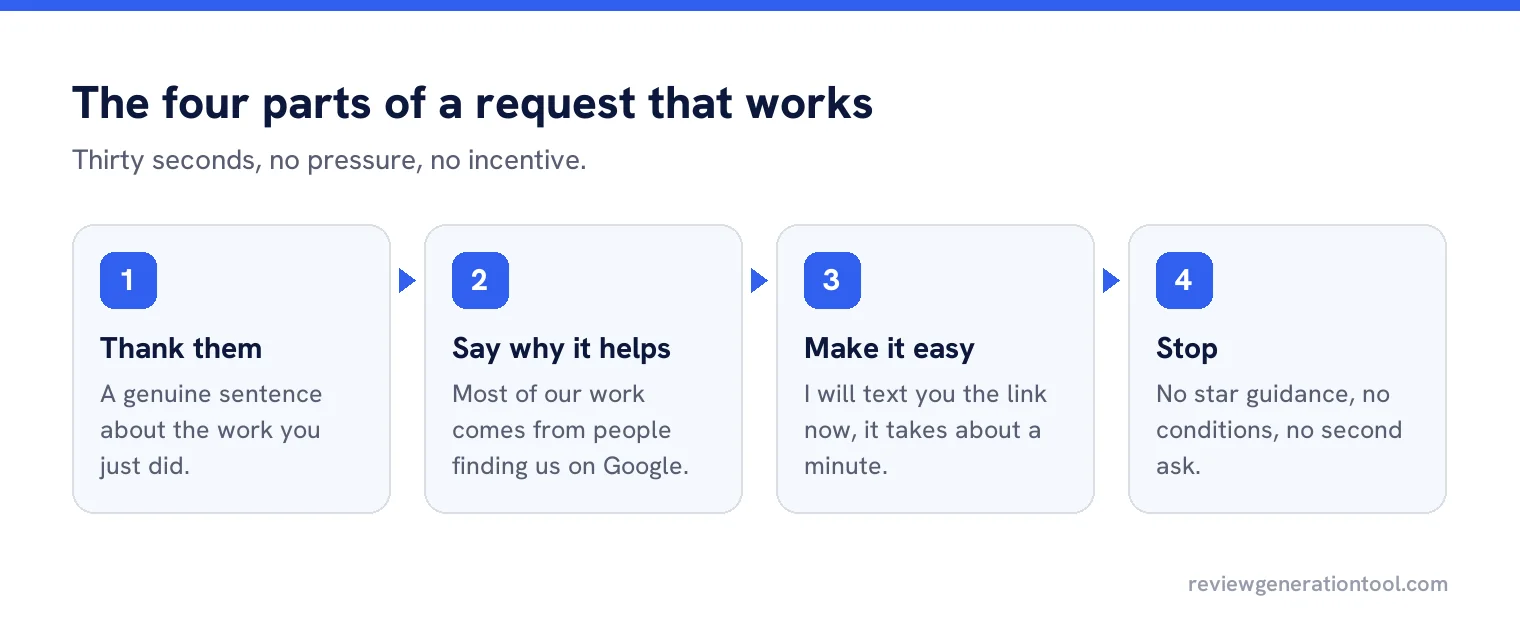
What a good ask sounds like
Thank them first
“Thanks for your business today.” Not a preamble, a genuine sentence.
Say why it helps
“Most of our work comes from people finding us on Google.” People help small businesses when they understand the help.
Make it easy
“I’ll text you the link now, it takes about a minute.”
Stop
No pressure, no star guidance, no “if you can’t give five, tell us first”.
Who should ask
The person who did the work. The fitter, the hygienist, the stylist, the engineer. Reviews asked for by the person who earned them convert several times better than an email from an address nobody recognises, because the customer is being asked by somebody they just met.
This is also why the office cannot own review generation on its own. The office can send the link; the ask has to happen where the service did.
Timing in one line
At the moment the customer is most pleased, which is usually immediately after the work is finished and before the invoice. There is more detail in our guide to when to send a review request, and the short version is that same-day beats next-week by a wide margin.
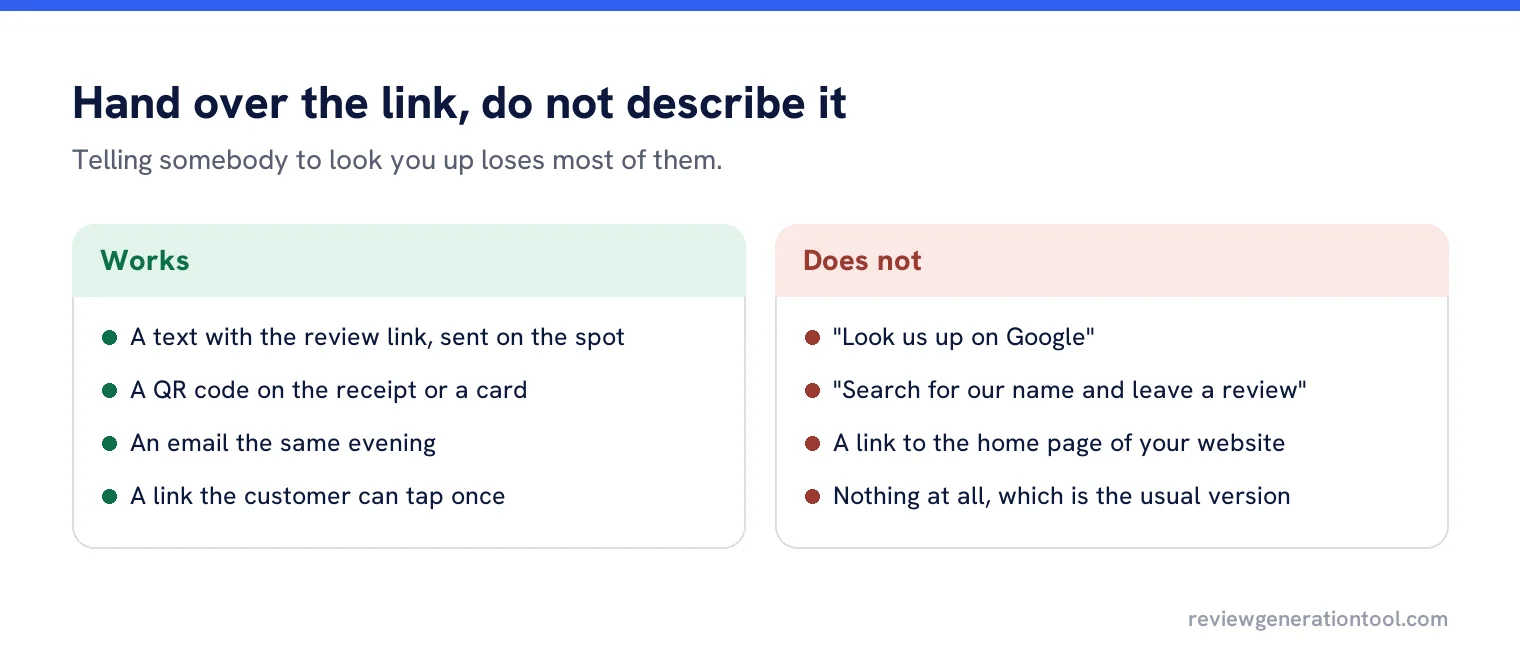
Hand over the link, do not describe it
Google’s own suggestion is to ask customers to visit a Google link or scan a QR code. Telling somebody to “look us up on Google and leave a review” loses most of them at the search step. A direct link opens the review box.
One thing worth knowing before you build a process around it: customers must be signed into a Google account to leave a review, though they can create one with a non-Gmail address. For some customer groups that is the whole of your conversion problem, and no amount of asking will fix it.
What not to say
- “If you were happy, leave a review.” This is filtering, and it breaks the spirit and often the letter of the rules.
- “We’re aiming for five stars.” Coaching the rating is not asking for feedback.
- “Leave a review and we’ll knock something off.” Prohibited outright.
- “Can you mention the kitchen fitting in Harrogate?” Dictating content reads as fake to everyone, including the reader.
A worked script
A plumber finishing a boiler service. “That’s all done, and the pressure’s back where it should be. Can I ask a favour? Most of our work comes from people finding us on Google, and a review from you would really help. I’ll text the link while I’m packing up, it takes a minute.”
Thirty seconds, no pressure, no incentive, no guidance on what to write. The text arrives before they have made a cup of tea, which is the part that converts.
When the customer says yes and nothing happens
Most people who agree to leave a review mean it at the time. Then they get home. The gap between the promise and the review is where almost all the loss happens, and it is closed by two things: sending the link while you are still standing there, and one reminder a few days later.
That is the whole of the follow-up strategy. A single reminder recovers a meaningful share of the people who intended to and forgot, and a second one annoys them. If somebody has not responded after one nudge, they have decided, and the answer is no.
Difficult customers, and the temptation to skip them
Everybody wants to skip the customer who was hard work. Resist it, for two reasons. The first is that filtering who you ask is exactly the behaviour the rules exist to prevent. The second is that a profile of nothing but glowing five star reviews reads as arranged, and customers are better at spotting that than businesses think.
A few honest four star reviews mentioning a delay or a snag make the rest believable. Google says much the same thing: a mix of positive and negative feedback often feels more trustworthy.
Making it a habit, not a campaign
Campaigns produce a spike and then silence, which is the review shape that looks worst. The alternative is one sentence in the end-of-job routine, the same way nobody forgets to take payment. Put it on the job sheet, mention it in the weekly meeting for a month, and then stop mentioning it because it has become normal.
Industries where asking is harder
Some trades genuinely cannot ask at the end of the job: funeral directors, some medical practices, anybody dealing with people in distress or with legal sensitivities. The answer is not to stop asking but to move the ask away from the moment and into the written follow-up, worded carefully and sent once. A line at the bottom of a thank-you letter is appropriate where a conversation at the door is not.
Tracking without turning it into pressure
Count asks and reviews at business level, not per staff member on a leaderboard. The moment review counts become an individual target, somebody starts filtering who they ask, and filtering is where the rule breaking begins.
Make asking the easy part
Send review links by text or email the moment a job is done, and see which locations and staff are actually asking.
Frequently asked questions
Can I offer a discount for a review?
No. Google says offering incentives such as free or discounted goods or services in exchange for reviews is fake and misleading content, and is strictly prohibited.
Who should ask for the review?
The person who did the work. An ask from the fitter or the hygienist converts far better than an email from an address the customer does not recognise.
What should I actually say?
Thank them, explain that most of your work comes from people finding you on Google, say you will send the link now, and then stop talking.
Is it alright to ask only happy customers?
No. That is filtering, and it breaks the spirit and often the letter of the rules. Ask everyone, in the same way, at the same point.
Do customers need a Google account to leave a review?
Yes. They must be signed in, although an account can be created with a non-Gmail address. For some customer groups this is the real barrier.
Sources
The Google documentation behind the guidance on this page. Google changes these pages without notice, so check the date on any figure before you rely on it.