
Field businesses have the best opportunity and the worst follow-through: the engineer is standing in front of a pleased customer and then drives away. Fix it with three things. The person on site asks, in one sentence. The link goes out automatically when the job is marked complete, that same day. And nobody in the office has to remember anything. Everything else, including incentives and leaderboards, makes it worse.
Getting reviews from field and service jobs starts with a moment shop businesses would envy. Plumbers, electricians, engineers and installers that shop businesses would envy: a customer whose problem has just been solved, in their own home, with nothing else happening.
Why field reviews get lost
The engineer is the only one there
And they are thinking about the next job, the traffic and the parts order.
The office does not know it finished
Until the paperwork comes back, which may be Friday.
Nobody owns it
The engineer assumes the office asks, the office assumes the engineer did.
The customer moves on
By the evening the boiler working is normal again.
The sequence that works
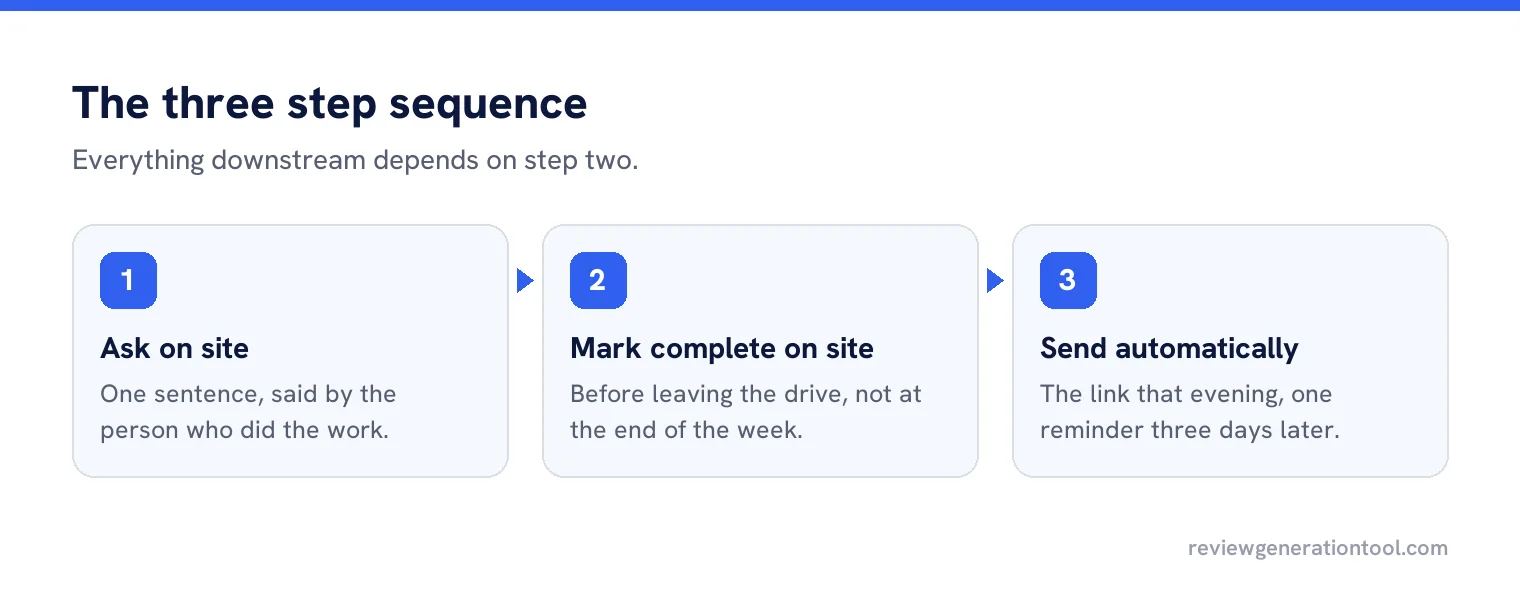
Three steps, in this order, every job.
- On site: “If you have a minute, a Google review really helps us. The office will text you the link.”
- On the phone: the engineer marks the job complete before leaving the drive.
- Automatically: the link goes out that evening, with one reminder three days later.
The important part is the second step. Everything downstream depends on the system knowing the job is finished, which is why the completion tap has to happen on site rather than at the end of the week.
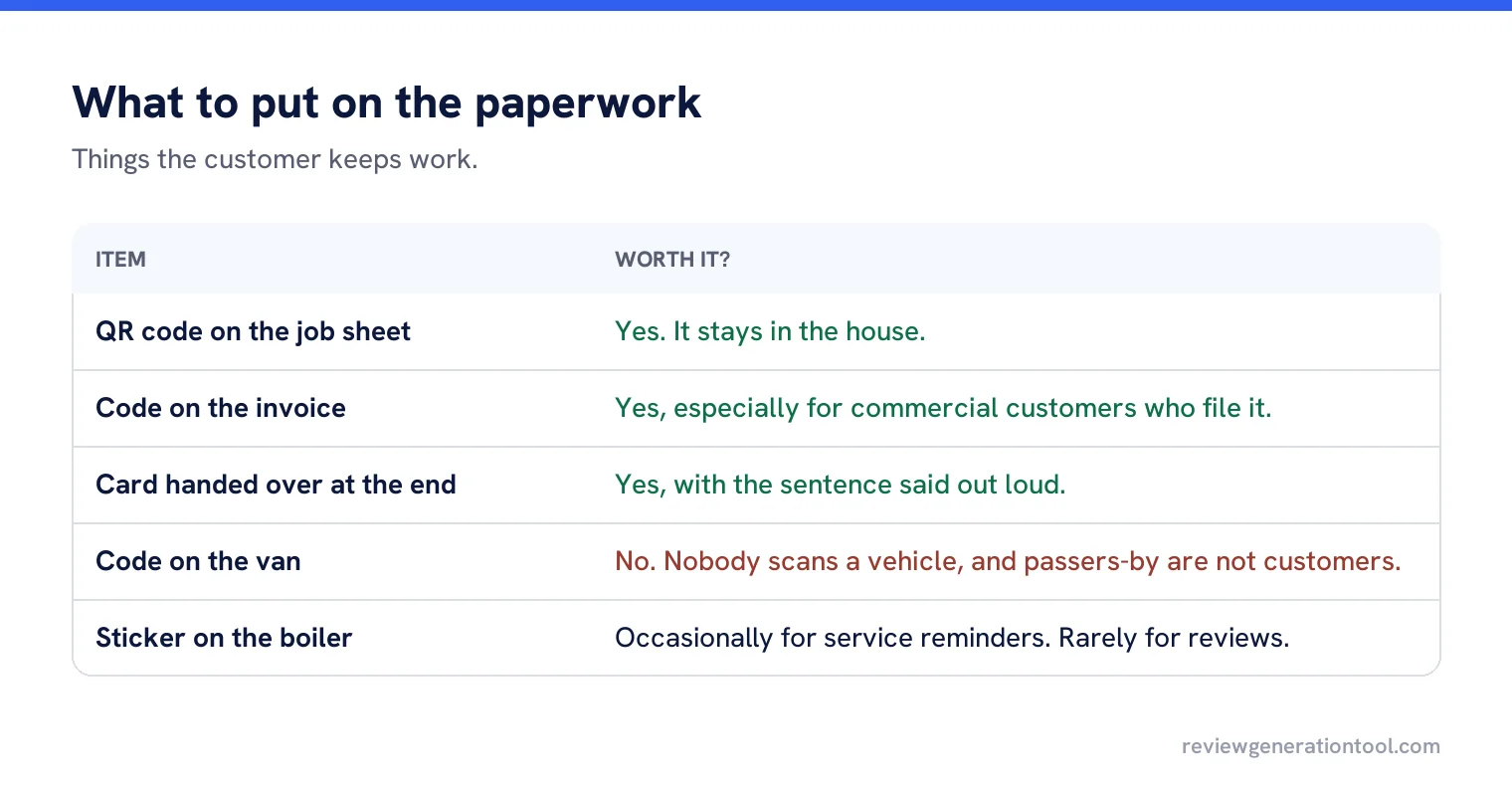
What to put on the van and the paperwork
| Item | Worth it? |
|---|---|
| QR code on the job sheet left with the customer | Yes. It stays in the house. |
| Code on the invoice | Yes, especially for commercial customers who file it. |
| Card handed over at the end | Yes, with the sentence said out loud. |
| Code on the van | No. Nobody scans a vehicle, and passers-by are not customers. |
| Sticker on the boiler or meter | Occasionally, for service reminders. Rarely for reviews. |
The engineer’s part, kept small
One sentence and one tap. Anything more will not survive a bad day. Do not ask engineers to collect email addresses, explain the process, or check if the customer has a Google account; those belong to the office or the system.
And never make it a target per engineer. The moment reviews appear on a performance chart, somebody starts asking only the easy customers, and somebody else stops mentioning the jobs that went badly.
Commercial and landlord work
For jobs where the payer is not the person on site, decide early who to ask. The tenant saw the work; the landlord pays the bill. Usually the person who experienced the service is the right one, provided they are the customer in any meaningful sense. For managed property work, the sensible default is to ask the managing agent once a quarter about the service overall, rather than asking a tenant about a visit they did not arrange.
Jobs with no customer present
Plenty of field work happens at empty properties: a void flat, a shop before opening, a site visit arranged by an agent. There is nobody to ask, and the temptation is to skip the request entirely. The better habit is to send it to whoever booked the work, worded for their experience of the service rather than of the visit: how easy it was to arrange, timekeeping on the day, and how quickly the report arrived.
Emergency callouts
These produce the strongest reviews, because the relief is real, and the worst timing, because it is often the middle of the night. Send the request the following day rather than at three in the morning, and mention the circumstance in the ask: “if you get a minute after the week you’ve had”.
A worked setup
A heating company with six engineers. Jobs are completed in a mobile app on site. Completion triggers a text at the next hourly batch between eight and seven, from a sender name matching the business, with a link on the company domain.
Engineers say one sentence and have no other involvement. The office sees replies in a shared inbox each morning. Nobody is measured individually, and the weekly team message lists the reviews that named somebody.
Their review rate went from roughly four a month to around twenty, with no incentives, no campaigns and no new software beyond what the job app already did.
What to do about the jobs that went wrong
Mark them, and let the system skip the request until the problem is closed. That is sequencing rather than filtering, and it needs to be deliberate: an automated request sent the evening after a disputed job will produce exactly the review you expect.
Multi-location and multi-crew businesses
Larger field businesses hit a problem single-van operations do not: which profile should the review go to? A company with depots in four towns has four profiles, and a job in one area should produce a review on that area’s listing. Sending every request to the head office profile concentrates reviews where no customer searches.
The fix is to tie the link to the depot rather than the business, using the same record that holds the store codes. It is a five minute configuration that is almost never done, and it is the reason so many branch profiles sit at a handful of reviews while head office has hundreds.
Subcontractors
Work delivered by subcontractors still produces reviews about your business, which is a reason to care about how they behave and a reason to keep the asking in your own hands. Do not ask a subcontractor to request reviews on your behalf; send the request from the business, after the job is marked complete, exactly as you would for your own staff.
Measuring it
Jobs completed, requests sent, reviews received, per week. The first two should be almost equal; if they are not, completions are not being marked on site. That single comparison usually explains the whole of a field business’s review problem.
Trigger the request when the job is done
Connect job completion to a review request, with one reminder, a clean stop and nothing for the office to remember.
Frequently asked questions
Why do field businesses struggle to get reviews?
The engineer is the only one present and is thinking about the next job, the office does not know the job finished, and nobody owns the ask.
What should the engineer do?
Say one sentence and mark the job complete before leaving. Everything else, including sending the link and chasing, belongs to the system or the office.
Should review numbers be a target for engineers?
No. Individual targets lead to selective asking and quiet omission of the jobs that went badly. Measure the business, recognise the reviews that name people.
Who should be asked on a landlord or commercial job?
Usually the person who experienced the service, provided they are the customer in a meaningful sense. For managed property, ask the agent periodically instead.
What is the one number to watch?
Jobs completed against requests sent, weekly. If they differ, completions are not being marked on site, which is usually the whole problem.
Sources
The Google documentation behind the guidance on this page. Google changes these pages without notice, so check the date on any figure before you rely on it.