
Business clients review less often, more slowly and more carefully, so the approach changes. Ask the person who felt the benefit rather than the person who signs the invoice, ask at a milestone rather than at the end of a job, make it easy for them to clear it with whoever has to approve public comment, and accept that a smaller number of substantial reviews is the realistic outcome. Everything else, including incentives, is the same as consumer work: not allowed.
Getting reviews from business clients looks impossible from the inside, and B2B firms often conclude reviews are not for them. Then a prospect searches their name before a meeting and finds four reviews, two of them from 2021.
Why it is harder
There are several people
The user, the manager, the buyer and the person who signs. Only some of them experienced anything.
Public comment may need approval
In larger organisations, saying anything in public about a supplier is a policy matter.
The relationship is ongoing
There is no neat finish, so there is no obvious moment.
People move
Your champion changes job and the relationship restarts.
Who to ask
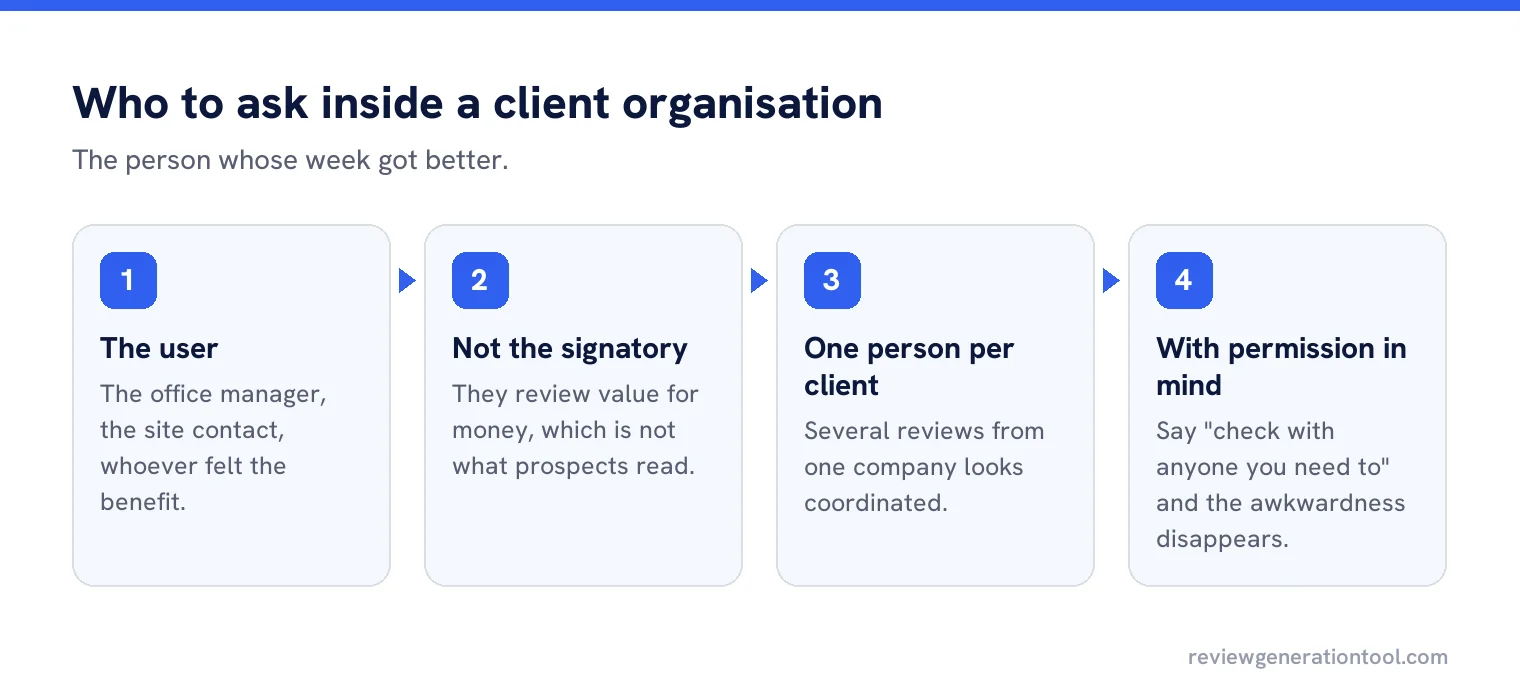
The person whose week got better. For an IT provider that is usually the office manager rather than the finance director. For a commercial cleaner it is whoever noticed the building was clean. Asking the signatory produces a review about value for money; asking the user produces a review about the service, which is what prospects want to read.
Where a single person is both, which is common in small firms, the job is easier and the timing matters more.
When to ask
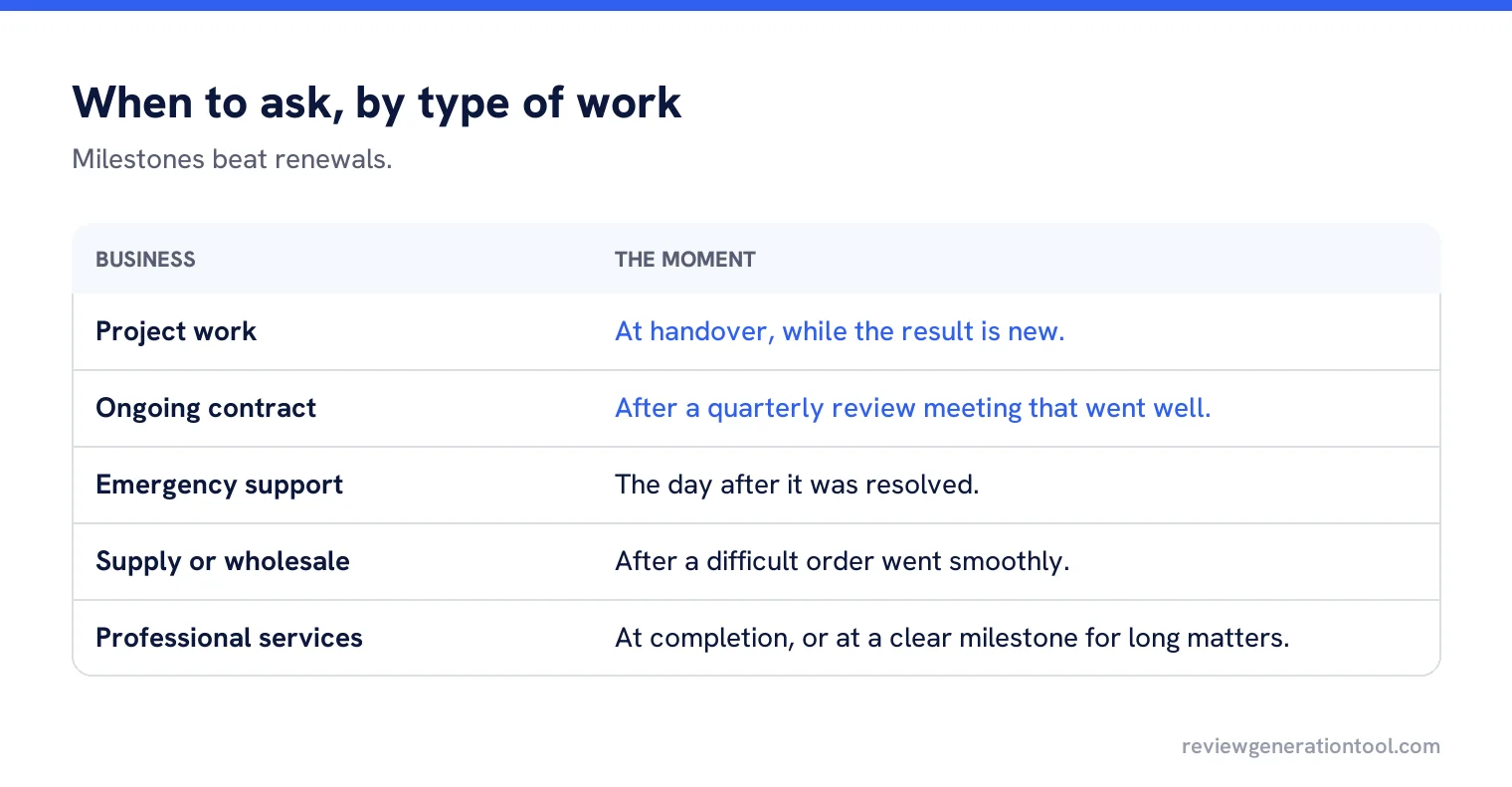
| Business | The moment |
|---|---|
| Project work | At handover, while the result is new. |
| Ongoing service contract | After a quarterly review meeting that went well. |
| Emergency or out of hours support | The day after it was resolved, when the relief is still fresh. |
| Supply or wholesale | After a difficult order went smoothly, not after a routine one. |
| Professional services | At completion, and for long matters at a clear milestone. |
How the ask should sound
More formal than a consumer ask, and still short. “We are trying to build up our Google reviews, and a few words from you about how the installation went would carry more weight than anything we could write ourselves. It takes a couple of minutes: [link]. If you need to check with anyone first, no problem at all.”
That last sentence is the one that unlocks corporate clients. It acknowledges that they may need permission, which removes the awkwardness of them having to say so.
Making approval easy
Offer to send a draft of what they might say, clearly marked as a starting point they should change. This is not writing their review for them, and the line matters: suggesting themes is fine, supplying text to be copied is not, and anything that produces identical reviews across clients looks exactly like what it is.
A better version is a list of three questions: what problem were you trying to solve, what did we do, what changed. Most people can answer that in four sentences without needing any draft at all.
Where the review should go
For most B2B businesses the Business Profile still matters, because prospects search the company name and read what is there. Industry directories and platforms matter too, and the honest answer is that you will not get all of them from one client. Pick the one that matters most for each client and ask for that one, rather than sending a list.
A worked example
A commercial landscaping firm with 40 contracts and six reviews. The office had been asking the finance contacts at renewal, which is the worst possible combination of person and moment.
They changed two things. They asked the site contact, the person who walked the grounds every day, and they asked two weeks after the first full cut of the season rather than at renewal. They also added the permission line.
Six reviews became twenty-two in a year, and the new ones mentioned specifics: response times after storm damage, the state of the car park in autumn. Those details did more for new business than the star rating.
Reviews written by one person about a company
One practical oddity of B2B reviews: the reviewer is an individual with a personal Google account, writing about work their employer paid for. Some people are uncomfortable attaching their own name to a supplier endorsement, particularly if they expect to change jobs.
There is no way around this and it is worth naming in the ask. “If you would rather not have it under your own name, a reference I can share privately would be just as useful” gives them an honest alternative, and it means the relationship does not get awkward over something small.
Confidentiality and sensitive sectors
Some clients cannot name their supplier publicly, and some sectors make it difficult even where there is no formal rule. Accept it quickly rather than pushing. A client who cannot leave a public review can often give you a reference by phone, which is worth more in a sales conversation than a review would have been.
Keeping it on the account plan
In B2B the review ask works best as a scheduled item rather than a reaction. Put it on the account plan once a year, attached to a moment that is already in the calendar, and have the account manager rather than marketing make the request. A request from the person a client deals with every month is a different message from one sent by an address they have never seen.
What not to do
Do not offer a discount at renewal in exchange for a review. Do not write it for them. Do not ask every contact at the same company, which produces a cluster of reviews from one organisation and looks coordinated. And do not chase more than once; in a business relationship, a second reminder costs more than the review is worth.
Ask the right person at the right moment
Track who to ask and when across your client list, with requests that go out when a milestone is reached.
Frequently asked questions
Who should I ask for a review at a business client?
The person who felt the benefit, usually the day to day contact rather than the signatory. They write about the service, which is what prospects read.
When is the right moment for ongoing contracts?
After a quarterly review meeting that went well, or after a difficult situation was handled smoothly. Renewal is the worst moment to ask.
What if the client needs permission to comment publicly?
Say so in the ask. Adding "if you need to check with anyone first, no problem" removes the awkwardness and unlocks a lot of corporate clients.
Can I write a draft review for them?
Suggesting themes or three questions is fine. Supplying text to copy is not, and it produces near-identical reviews that look exactly like what they are.
Should I ask several people at the same company?
No. A cluster of reviews from one organisation looks coordinated. Pick the right person and ask once.
Sources
The Google documentation behind the guidance on this page. Google changes these pages without notice, so check the date on any figure before you rely on it.